

· AFX Research
What Happens to an Easement When the Burdened Land Is Divided
Splitting the land that carries an easement does not split the easement. It multiplies the owners who carry it, and the new lot chains can look completely clean.
Table of Contents
Dividing the land that benefits from an easement raises one set of questions. Dividing the land that is burdened by it raises a different set, and the second is the one that reaches ordinary buyers more often, because subdivisions are carved out of burdened farmland constantly.
The short answer is that the easement survives the split intact. It does not shrink, it does not get allocated among the new parcels, and it does not become somebody else’s problem. It simply now runs across property belonging to several people instead of one.
What the split does
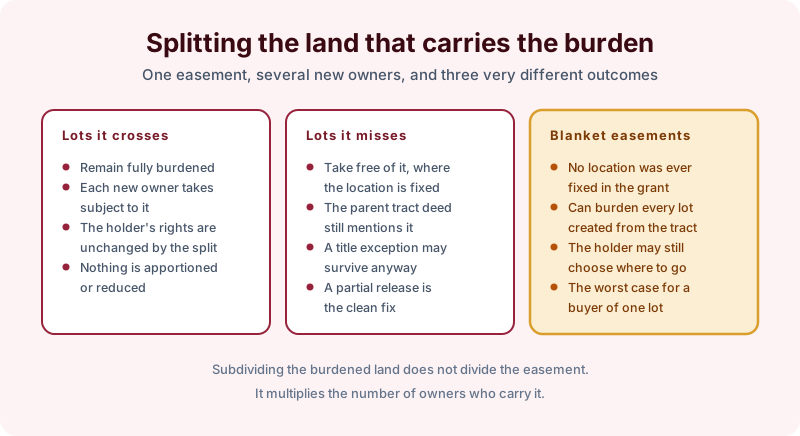
Where the easement has a fixed location, the outcome is reasonably clean. Lots the easement crosses remain fully burdened and each new owner takes subject to it. Lots it does not touch are free of it in substance, although the exception may well survive in their title work until somebody obtains a partial release, which is one of the routine uses of relocating or amending an easement.
The holder’s position does not change at all. A pipeline company with a thirty foot strip across a farm has exactly the same thirty foot strip after the farm becomes forty houses. What changes is that enforcing it now involves several owners rather than one, and that maintenance and access obligations are spread across them.
Blanket easements are the difficult case. Where the original grant never fixed a location, and many older utility and access grants did not, the holder retains some latitude about where to go. Dividing the tract can leave every resulting lot burdened by an easement whose route has still not been settled, which is the situation described in blanket easements with no defined location.
Why the new lot chain looks clean
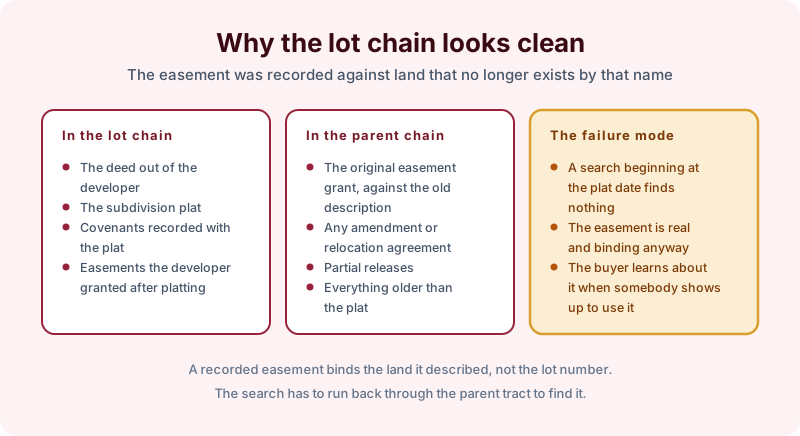
This is the practical failure, and it is a recording problem rather than a legal one.
The easement was recorded decades ago against a legal description that no longer corresponds to anything. It described a quarter section, or a metes and bounds tract, and that tract has since become Lots 1 through 40 of a named subdivision. A search that begins with the plat and works forward sees the developer’s deed, the plat, the covenants recorded with it, and nothing else. It returns clean.
The easement is nonetheless binding on the lot, because it bound the land before the land was divided and nothing has released it. Finding it requires running the chain back through the parent tract, past the plat, into the period when the description was different. That is ordinary abstracting work, and it is the step that gets skipped when a search is scoped tightly to a residential lot.
Where it goes wrong on the ground
A buyer closes on a new house, and eighteen months later a utility crew arrives to work on a line across the back of the lot. The easement was recorded in 1974. The subdivision was platted in 2019. The title work started in 2019.
The same pattern produces the disputes in building near an easement, because a builder who did not know about the strip put a shed, a pool or part of a driveway on it.
Scoping the search
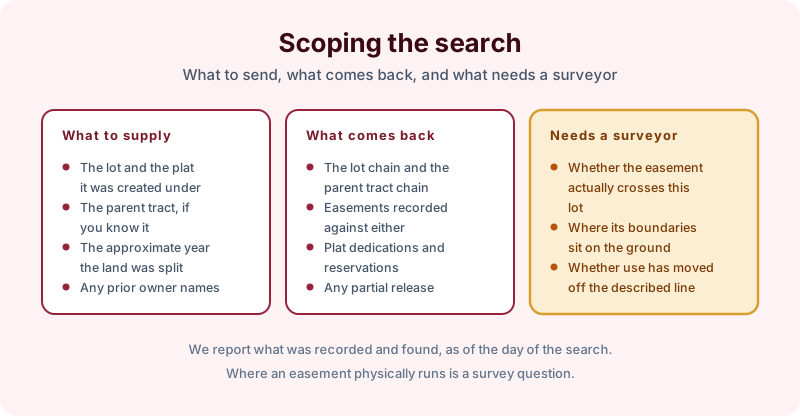
Give us the lot and the plat, and tell us roughly when the land was split if you know. We will run the lot chain and the parent tract chain behind it, which is where anything older than the subdivision lives.
What the record cannot settle is whether the easement physically crosses this particular lot, or where its edges fall relative to a fence or a foundation. Those are survey questions, and on a blanket easement they may not have an answer yet at all.
The takeaway
Subdividing burdened land divides the ownership, not the burden. Every lot the easement crosses carries it in full, blanket easements may reach lots nobody expected, and the lot chain created at platting will not show any of it.
Search back through the parent tract. Tell us the lot and the plat or order a search.